A new European satellite has given us a new way to monitor the impact of earthquakes. Sentinel measure the small changes in the position of parts of the Earth's crust by comparing 'before' and 'after' images of an area that has experienced an earthquake. Analysis of these results can show where stresses in the crust are being concentrated which may allow for predictions to be made about the location of subsequent tremors.
In the search to find a method of effectively predicting seismic events, any new tool that can contribute has to be welcomed.
The earthquake hazard map of the USA has a major seismic puzzle. It's not the high hazard in California (CA) caused by the San Andreas Fault or in Washington (WA) and Alaska (AK) easily explained by the occurrence of subduction zones around the Pacific Ring of Fire. There is another high hazard zone along the Mississippi River further east.
Harri P in Year 12 drew my attention to this odd occurrence of earthquakes thousands of kilometres from a plate boundary. There have been some major seismic events in this region, in particular the magnitude 7 New Madrid earthquakes of 1811-12. The cause of these 'quakes was a puzzle until a few years ago when a team of geologists from the University of Quebec discovered a slab of crust that is descending into the mantle, disrupting the flow of the mantle and the crust in this area. It is similar in some ways to a subduction zone but without the fold mountains, trench and volcanoes. It does pose a continuing danger of creating major earthquakes.
It is a very strange phenomenon and goes to show just how much we still have to discover about how the crust and the mantle work.
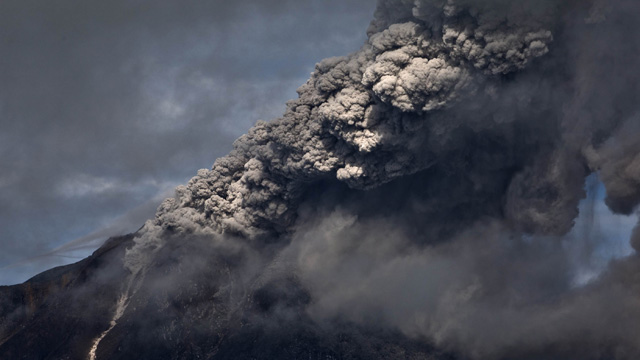
Mt Sinabung has erupted. It is a volcano on the Indonesian island of Sumatra that has been showing signs of activity for a while. It is unfortunate that an evacuation in September finished on Friday with the result that the death toll as I write this is 14 people. It does show the dangerous unpredictability of volcanoes. You can see photos of the eruption here.
Most of the world's volcanoes are found around the rim of the Pacific Ocean and every so often one of these volcanoes bursts into activity, just as a reminder about the tectonic instability that creates all this volcanic activity. Chaparrastique, a volcano in El Salvador, has erupted for the first time since 1976. It isn't a particularly big eruption with the production of hot ash causing the evacuation of surrounding settlements. Overall it isn't a big event, but it does give us all a reminder about the ever-present potential for volcanic and seismic disaster around the "Pacific Ring of Fire".
It is worth checking out the news story for the video showing the eruption and its plate tectonic setting.
Los Angeles will be struck by a devastating earthquake.... soon. We don't know when but we do know that it will happen. By recording the earthquakes along the San Andreas Fault for nealry the last 200 years it is very apparent that through the 20th century the fault hasn't moved much comapred to the frequent earthquakes along the fault during the 19th Century. Contrary to what many people would think, geologists know that this is a "bad thing" because if the fault is locked, energy is being built up in the fault so that when it moves it will move a lot.
At the American Geophysical Union conference in San Fransisco, geoscientists from the US Geological Survey have been posing the question "is LA ready for a megaquake?"
Read through the article, do you think that they can cope with a shock on the scale predicted?
A Piggyback Thrust is a type of reverse fault created by extreme compression of the crust during a plate collision. The "piggyback" is where several thrust faults occur in succession. this is one of the key aspects of an orogeny, where mountains are built.
The far northwest of Scotland shows a superb example of this called the Moine Thrust (shown in the cross section above). This area was key for geologists to understand the process of mountian building, before plate tectonics was even discovered.
A big earthquake has struck southern Pakistan. A magnitude 7.7 seismic event has killed at least 30 people in Balochistan Province and been felt around much of the region.
This is a big earthquake but the death toll may not rise too high (though any deaths are a tragedy for the people involved). This area is sparsely populated and poor; many of the houses are low-rise and made of mud so when they collapse in the shaking, they are less likely to kill than stone structures. There is a real danger though of more people dieing in the aftermath of the event from food, shelter and water shortages than died in the earthquake itself.
UPDATE: 25/9/13
The death toll has , unsurprisingly, risen to over 200 at the latest count. More surprising has been the appearance of a new island off the coast of Pakistan. As the stress has changed in the plate, it has deformed to push the sea bed above sea level to make new land.
A slideshow of photographs from the area affected.
A guyot (or seamount) is a submerged, extinct volcano. There are chains of such volcanoes streching across the Pacific Ocean in particular that are very important in our interpretation of past plate movements and hot spot theory.
I chose this as "Word of the Week" because the biggest volcano on Earth has recently beeen discovered in the Pacific Ocean. The scale of this is staggering (it is over 15 times the area of Wales) and has been compared to the biggest volcano we kow of - Olympus Mons on Mars. What is really surprising is that we have only just discovered something so big - it does give the exciting prospect of what else is there to discover about our planet....