
Showing posts with label Earth Processes. Show all posts
Showing posts with label Earth Processes. Show all posts
Thursday, 11 September 2014
Stopping Lava

Wednesday, 10 September 2014
Earthquakes from Space

A new European satellite has given us a new way to monitor the impact of earthquakes. Sentinel measure the small changes in the position of parts of the Earth's crust by comparing 'before' and 'after' images of an area that has experienced an earthquake. Analysis of these results can show where stresses in the crust are being concentrated which may allow for predictions to be made about the location of subsequent tremors.
In the search to find a method of effectively predicting seismic events, any new tool that can contribute has to be welcomed.
Black Smoker
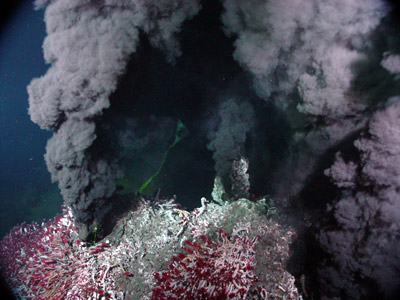
A black smoker is a hydrothermal vent on the sea bed, often found around constructive plate margins. Superheated water is erupted into very cold seawater causing dissolved sulphide minerals to be precipitated (thereby creating the 'smoke'). Finding ancient deposits that were formed this way can be very lucrative as they can be rich in metal ore minerals. You can find out more by watching this YouTube video.
Monday, 1 September 2014
Badaboom Volcano

For the latest updates, check out the website of the Icelandic Meteorological Office.
Thursday, 6 March 2014
The oldest bit of the Earth

Thursday, 20 February 2014
Did you feel it?

We had an earthquake today! A magnitude 4.1 tremor with its epicentre in the Bristol Channel, just north of Ilfracombe was recorded by the British Geological Survey at 1.21pm.
No reports of damage yet, not even knick-knacks falling! Have a look at a 'VI' on the Mercalli Intensity scale.
Wednesday, 19 February 2014
Seismic Puzzle

Harri P in Year 12 drew my attention to this odd occurrence of earthquakes thousands of kilometres from a plate boundary. There have been some major seismic events in this region, in particular the magnitude 7 New Madrid earthquakes of 1811-12. The cause of these 'quakes was a puzzle until a few years ago when a team of geologists from the University of Quebec discovered a slab of crust that is descending into the mantle, disrupting the flow of the mantle and the crust in this area. It is similar in some ways to a subduction zone but without the fold mountains, trench and volcanoes. It does pose a continuing danger of creating major earthquakes.
It is a very strange phenomenon and goes to show just how much we still have to discover about how the crust and the mantle work.
Friday, 14 February 2014
Eruption!

Wednesday, 1 January 2014
Reminder from the "Ring of Fire"

Most of the world's volcanoes are found around the rim of the Pacific Ocean and every so often one of these volcanoes bursts into activity, just as a reminder about the tectonic instability that creates all this volcanic activity. Chaparrastique, a volcano in El Salvador, has erupted for the first time since 1976. It isn't a particularly big eruption with the production of hot ash causing the evacuation of surrounding settlements. Overall it isn't a big event, but it does give us all a reminder about the ever-present potential for volcanic and seismic disaster around the "Pacific Ring of Fire".
It is worth checking out the news story for the video showing the eruption and its plate tectonic setting.
Thursday, 12 December 2013
How big???!!!???

Yellowstone is a big volcano - a really big volcano - so big a volcano we call it a supervolcano. It turns out that Yellowstone is actually much bigger than we had previously thought - 2.5 times bigger according to Professor Bob Smith from the University of Utah. This means that the magma chamber contains a staggering 200-600 cubic kilometres of molten rock.
Seismic surveys of the volcano have reavealed the true extent of the magma source, created by a sub-continental hot spot. Don't worry too much though, supervolcanoes don't erupt very frequently and Yellowstone doesn't look like it will erupt imminently....probably.
You can check out the Yellowstone Volcano Observatory and assess the risk yourself.
Waiting for "The Big One"

Los Angeles will be struck by a devastating earthquake.... soon. We don't know when but we do know that it will happen. By recording the earthquakes along the San Andreas Fault for nealry the last 200 years it is very apparent that through the 20th century the fault hasn't moved much comapred to the frequent earthquakes along the fault during the 19th Century. Contrary to what many people would think, geologists know that this is a "bad thing" because if the fault is locked, energy is being built up in the fault so that when it moves it will move a lot.
At the American Geophysical Union conference in San Fransisco, geoscientists from the US Geological Survey have been posing the question "is LA ready for a megaquake?"
Read through the article, do you think that they can cope with a shock on the scale predicted?

Friday, 22 November 2013
Earth Explorer

In order to try to understand the field it is essential that we make a map of it. The European Space Agency has launched three satellites today to map the field. They will hopefully provide some answers about a crucial aspect of the Earth's physics and possibly help to find mineral resources as well.
This mission is part of the ESA's Earth Explorer Programme.
Thursday, 21 November 2013
An island is born

Every so often a volcano erupts out of the ocean to form a new island. The most famous of these is an island called Surtsey, close to Heimaey off the south coast of Iceland. Since it emerged in 1963 it has been intensively studied by geologists and biologists to investigate rates of erosion and colonisation of new landmasses.
This formation of a new island has happened again, this time off the coast of Japan. Video of the eruption (taken from planes flying over the volcano) clearly show the volcanic processes that have built the volcano to such an extent it has grown above sea level.
Monday, 18 November 2013
Griffith Crack

Friday, 1 November 2013
Boudinage

Boudinage is from a French word meaning "sausages". It is a distinctive structure formed by extension of a competent rock under tensional stress where it is surrounded by incompetent rock. The competent rock starts to break up forming the sausage-like structures shown in the photograph. This can even happen on a microscopic scale within a rock where the process is called Rodding.
Monday, 21 October 2013
Probably not the end of the World.

Meteorites are beautiful and fascinating things that can tell us a lot about the early Earth and its formation. However there is a downside to them - ask the dinosaurs! Oh wait.. you can't....
Anyway for all the doom-mongers out there; an asteroid (2013 TV-135) has been recently discovered and, after doing a bit of maths, it has been calculated that it will make a near Earth pass in 2032. However, despite some uncertainty about its orbital path, there is only a 1 in 63,000 chance that it will hit us. To put this another way there is a likelihood of 99.998% that it won't hit us in 2032.
So we can rest safe in our beds.
Probably.
Thanks to Rosie for spotting this story.
Friday, 18 October 2013
Piggyback Thrust

The far northwest of Scotland shows a superb example of this called the Moine Thrust (shown in the cross section above). This area was key for geologists to understand the process of mountian building, before plate tectonics was even discovered.
The rock that fell to Earth

The meteorite that fell into a Russian lake has been recovered. 570 kg of material has been collected from the lake bottom and should give more clues about the origin of the rock and, perhaps, the origin of our planet. Metoerites are the left-overs from planet formation and give us our best evidence about the composition of the deep Earth and its age.
Monday, 14 October 2013
Core blimey!

New research on the movement of iron through silicate rocks by Stanford Unversity has the potential to change our view about how the Earth's core formed. Professor Wendy Mao and her team have discovered that iron can percolate through silicate minerals which means that our idea of the mantle and core being distinct bodies from the earliest stage of formation of the planet may be wrong. Instead we can have a model where after our planet aggregated there was a gradual evolution of the internal structure as the materials differentiated by percolation under the influence of gravity.
The implications of this discovery may be that data we get from meteorites may not give us a good control on the bulk composition of the Earth. It seems that we have a lot more to discover about our planet.
Friday, 20 September 2013
Permitted intrusion

A permitted intrusion is an igneous intrusion where the space that it occupies has been created by forces other than those created by the intrusion of magma. For example if a volcano collapses after eruption in a cauldron subsidence event to make a caldera, any magma intruded along the faults that occur will follw those faults and result in a permitted intrusion. An example of this type of intrusion is a ring dyke.
Subscribe to:
Posts (Atom)